1896
2026
The Beginning
1900s
1910s
1920s
1930s
1940s
1950s
1960s
1970s
1980s
1990s
2000s
2010s
2020s
and Beyond
OUR STORY • OUR PEOPLE • OUR CLUB
From the Brink to a Dynasty
1980 - 1989

The 1980s became one of the most remarkable decades in Boulder City Football Club history. Few clubs have experienced such dramatic highs and lows within a single decade. It began with enormous promise, descended to the darkest period the Club had faced since its formation, and finished with the Tigers once again standing proudly at the summit of Goldfields football.
Across ten unforgettable seasons, Boulder claimed three League Premierships, two Reserves Premierships and two Colts Premierships, while a remarkable generation of players, coaches and volunteers rebuilt not only a football team, but an entire football club.
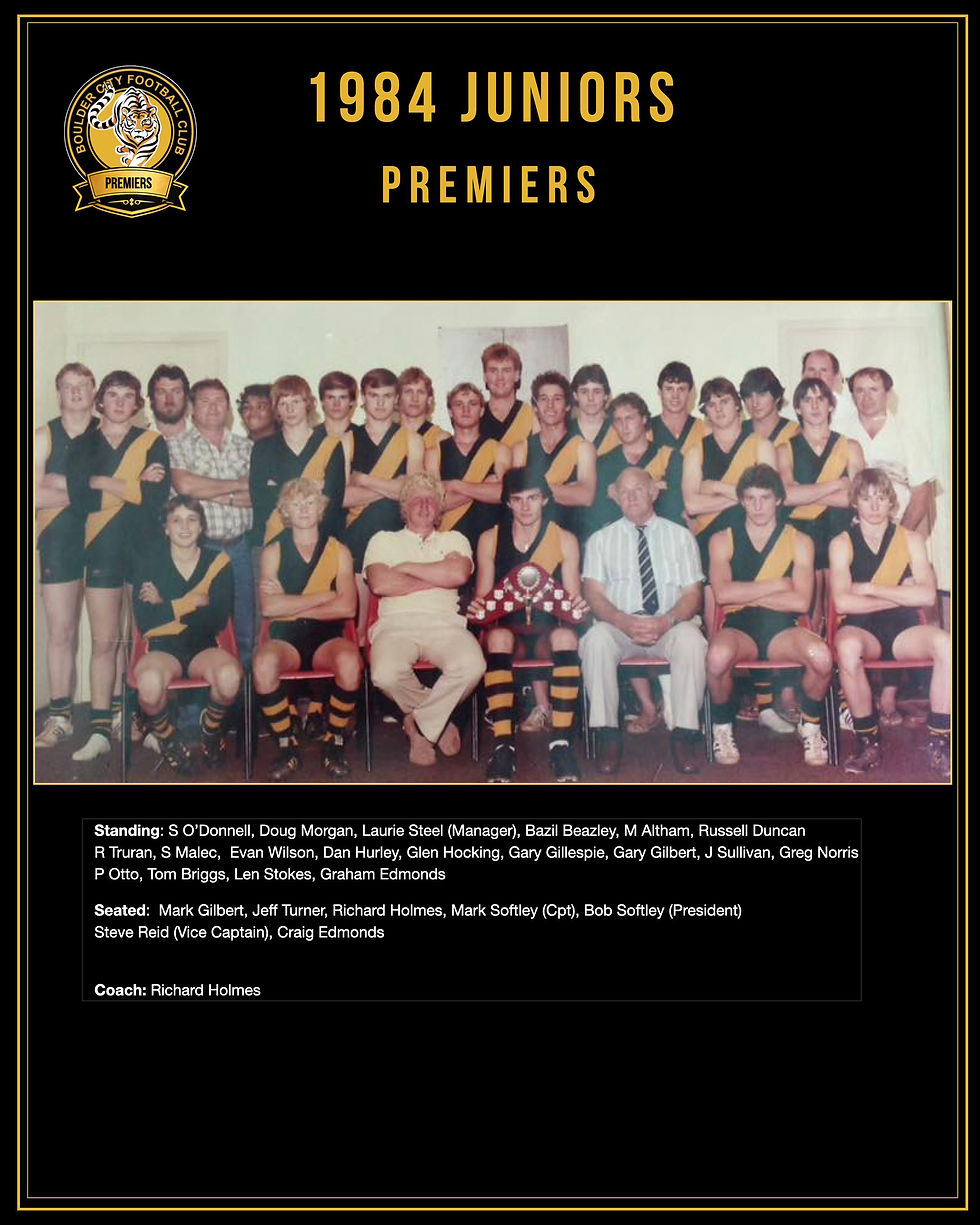
The foundations of the decade had been laid long before the premiership celebrations began. One man more than any other helped shape the future of Boulder football— Richard Holmes. Holmes developed one of the finest junior football programs the Goldfields had seen, coaching young Tigers through the under-age ranks before preparing them for Colts, Reserves and eventually League football. His teams played disciplined, attacking football and, more importantly, developed young men who understood what it meant to represent Boulder City. His coaching record was extraordinary.
-
Three Under-age Premierships.
-
Two Colts Premierships.
-
Two Reserves Premierships.
Many of the footballers he nurtured would form the backbone of Boulder's League success during the decade, proving that premierships are often won years before the Grand Final is played. While Holmes was building the future, another champion was emerging on the field.


Glenn OLoughlin
1980 - 1984
Few players have dominated individual honours as completely as Glenn O'Loughlin. Between 1980 and 1984 he won an extraordinary four consecutive Boulder League Fairest and Best Awards, a record that reflected his remarkable consistency and influence on the competition.
His brilliance was recognised well beyond Boulder Oval. Glenn captured the 1982 and 1983 Mitchell Medals as the Goldfields Football League's Fairest and Best player, firmly establishing himself among the elite footballers of his generation. His leadership, professionalism and standards would become central to Boulder City's resurgence throughout the decade.


The Tigers announced their return in 1982. Under coach Brian Macgregor, Boulder claimed its first League Premiership in five years, rewarding a group that had steadily developed through the club's junior ranks. The success was reinforced throughout the Club. The Colts
continued to flourish. The Reserves remained competitive. Young footballers were graduating into senior football with increasing confidence. It appeared Boulder had rediscovered its place among the Goldfields' leading clubs. Yet football can change quickly.
The success of 1982 proved difficult to sustain. Within only three seasons the Tigers found
themselves in unfamiliar territory. The 1985 season became one of the toughest in Club history. Boulder failed to win a single League match.
Premiers 1982


On the field, the situation was equally concerning. The Club carried significant debt, finances
were stretched, and confidence was at its lowest point in decades. Perhaps most alarming of all, discussions began about the possibility of amalgamating with cotenants Mines Rovers.
For a club founded in 1896, it was almost unthinkable. The Tigers were on the brink. History often turns on the determination of a handful of people. Rather than accepting defeat, several passionate Tigers refused to let the club disappear. Finance Director Bob Turner, together with Reg James, began developing a plan to restore the club ahead of its approaching 90th anniversary. Local businessman Max Viskovich accepted responsibility for recruiting players. Bob Turner committed himself to completing long-awaited extensions to the clubrooms.
Most importantly, Boulder appointed an untried coach from Railways with remarkably new ideas. His name was Gary Jones. Jones inherited a playing list rich with youthful talent developed through Richard Holmes' junior program, including Tony Shaw, Russell Duncan and Jeff Turner. The challenge was transforming that potential into a premiership side. Midway through the season came one of the boldest recruiting decisions in Goldfields football history.

STEPHEN MICHAEL ARRIVES
With finals still uncertain, Boulder searched for something extraordinary. They found it in one of the greatest footballers Western Australia has ever produced. Dual Sandover Medalllist, All-Australian captain and South Fremantle legend Stephen Michael agreed to join the Tigers on a fly-in, fly-out basis.
The clearance almost failed when Michael accidentally signed the paperwork incorrectly, forcing Boulder officials into a frantic race against the transfer deadline. The corrected documents arrived only hours before clearances closed. The Tigers had their champion. His first appearance at Boulder Oval became one of the most memorable days in Goldfields football history.
Spectators packed the ground well before bounce-down. Vehicle gates were closed as crowds overflowed into every available space. When Stephen Michael finally ran onto the ground during the opening quarter, a roar echoed across Boulder. Goldfields football had never witnessed anything like
it.
His presence lifted not only the playing group but an entire football club. What followed became one of the
greatest stories in Boulder history. Only twelve months after enduring a winless season, the Tigers charged
through the finals under Gary Jones. They defeated Railways in the first semi-final, Kambalda in the preliminary final and then met the powerful Kalgoorlie City in the Grand Final.
Inspired by Craig O'Loughlin's leadership, Stephen Michael's brilliance and a committed team built from years of junior development, Boulder produced one of the Club's most famous premiership victories.
The impossible had become reality. The Tigers were premiers once more. The transformation extended
beyond the scoreboard. By season's end Boulder had secured a League Premiership, completed major extensions to the clubrooms and returned the club to financial stability. A football club that had stood on the edge of extinction only twelve months earlier had been reborn.
The success of 1986 proved no miracle. It was the beginning of another golden era. The systems established through Richard Holmes' development program continued producing quality footballers. Gary Jones' premiership standards remained embedded throughout the Club. Under Des Hindson, Boulder added back-to back League Premierships in 1989 and 1990, confirming the Tigers as the dominant force in Goldfields
football once again.
Seven junior premierships under Richard Holmes. Four consecutive League Fairest and Best awards for Glenn O'Loughlin. Two Mitchell Medals. A legendary recruit in Stephen Michael. A generation of coaches including Brian Macgregor, Gary Jones and Des Hindson. Yet the greatest achievement of the 1980s cannot be measured by premiership cups or medals. The Boulder City Football Club survived. When the club faced its greatest challenge, ordinary people achieved extraordinary things.
-
Players inspired.
-
Coaches believed.
-
Volunteers worked tirelessly.
-
Supporters never walked away.
Together they transformed hardship into hope and ensured the Tigers would not simply survive—but flourish for generationsto come.


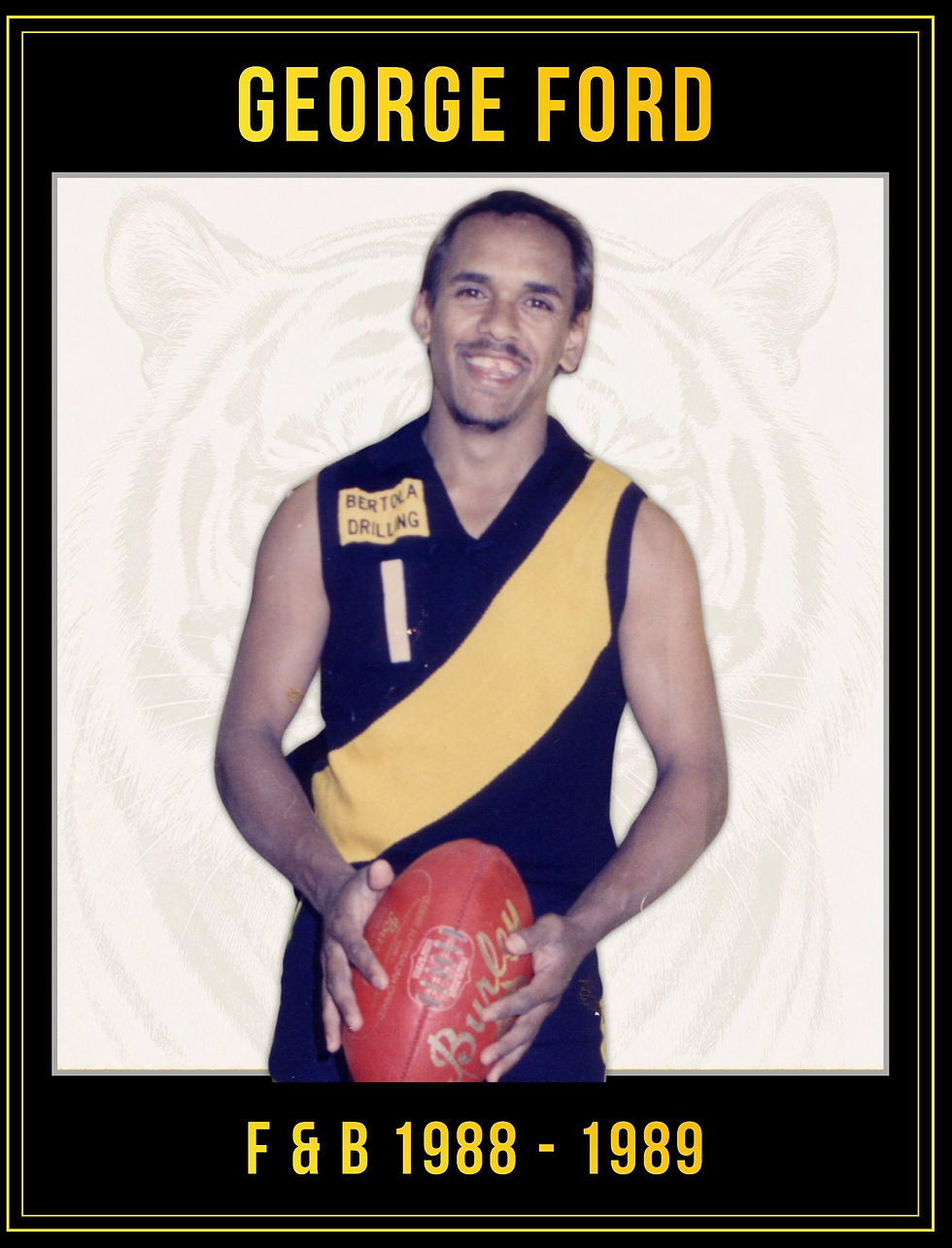
Fairest & Best
1984 - 1989