

Jack Leckie
THE PIONEER
Player - Captain - Coach - Selector - Legend
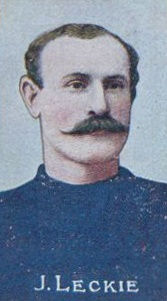

Long before professional coaching became part of Australian football, Jack Leckie was already showing how one strong leader could transform a team, a club and even an entire football region. Leckie arrived in Western Australia during the great Goldfields rush of the 1890s after beginning his football career in Victoria. He played with the Union side in Coolgardie’s inaugural association competition in 1895, captained Civil Service to a premiership the following year and led Rovers to another flag in 1897. Then came the move that would forever connect his name with the Tigers.
Building Boulder City
Leckie joined Boulder City as captain in 1898, the first season in which the club competed under its new name and adopted the amber and black colours. His impact was immediate: Boulder won the premiership in both 1898 and 1899. A treasured trophy still held by the Leckie family was presented to him following the 1899 premiership.
Leckie was more than an outstanding player. He was the organiser, teacher and driving force of the side. A 1921 newspaper profile credited teams led and coached by him with repeated premiership success and described his Goldfields career as both long and honourable. In 1901 he won the district trophy for the best all-round player and was also the leading goal-kicker. Two years later, he was recognised as the Goldfields’ champion goal-kicker.

THE FIGHT THAT SHOOK GOLDFIELDS FOOTBALL
Leckie’s Boulder years were not without controversy.
During the 1900 season he became involved in an on-field fight with an opposition player named Jennings. Leckie later claimed that Jennings had deliberately provoked him, adding with characteristic bluntness:
“I made use of my opportunity by getting home first. I always endeavour to get the first blow in.” Leckie was suspended for the remainder of the season. Boulder City, furious with the decision, voted to sever its relationship with the Hannans District Football Association. The dispute escalated until the Association disqualified Boulder for the remainder of 1900 and the following seasons.
It was one of the earliest major confrontations between the Tigers and football’s governing authorities—and an indication of just how strongly the club supported its captain. Leckie remained central to Boulder’s fortunes into the early 1900s. He was still at the helm when the Tigers contested the 1904 Grand Final, before eventually leaving the Goldfields for the metropolitan competition.
His career stretched from the dusty grounds of Coolgardie and Boulder to premiership success in Perth and the coaching of Western Australia’s first carnival-winning State team.
Yet for the Tigers, his story begins in 1898.
Jack Leckie took charge of a young Boulder City side, delivered consecutive premierships and helped establish the standards, identity and ambition of the emerging club. He was not simply one of Boulder’s first captains. He was one of the men who taught the Tigers how to win.
Jack Leckie — Career highlights at Boulder Football Club
-
Boulder Football Club Captain 1898 - 1904
-
Premiership Captain GFL 1898 & 1899
-
Premiership Captain BFL 1901 - best all-round player and leading goal-kicker
-
Goldfields Champion goal-kicker - 1903


From Boulder to the WAFL
Leckie joined Perth in 1906 and became captain-coach the following year. In 1907 he guided the club to its first premiership, a landmark achievement that secured his place in Perth Football Club history. Perth later recognised him as an inaugural member of its Hall of Fame.
His coaching journey eventually included appointments with several leading Western Australian clubs:
-
Perth
-
East Perth
-
South Fremantle
-
Subiaco
-
West Perth
At South Fremantle he served as captain-coach, while at Subiaco he coached the club to the 1915 premiership. His ability to organise players, establish discipline and develop winning football made him one of the most sought-after coaches of his era. Leckie also influenced the next generation. In 1918 he took charge of Christian Brothers’ College, guiding the school through an undefeated season in which his young players broke existing records. Premiership success followed again in 1920.
Western Australia’s Historic Victory
Leckie’s greatest coaching achievement came in 1921, when he was placed in charge of the Western Australian team at the Australian Football Carnival in Perth. Western Australia defeated the powerful Victorian and South Australian combinations to claim its first national carnival victory. It was a defining moment for football in the State and the high point of Leckie’s long career as a coach, selector and football strategist.
His appointment was no surprise to those who had followed his career. He had already selected representative teams, helped choose Western Australia’s 1914 carnival squad and repeatedly demonstrated an ability to recognise and develop football talent.
A Place Among the Greats
More than a century after he first led Boulder City, Jack Leckie received one of Western Australian football’s highest honours. In 2024, he was formally inducted into the West Australian Football Hall of Fame, recognising his enormous contribution as a pioneering player, premiership captain, coach and State selector.
His career stretched from the dusty grounds of Coolgardie and Boulder to premiership success in Perth and the coaching of Western Australia’s first carnival-winning State team.


