BOULDER CITY FOOTBALL CLUB · EST. 1896
Riley Miller
THE POLICEMAN WHO RULED THE CORRIDOR

PLAYER SNAPSHOT
ERA
1947 - 1948 & 1949
BCFC
All-Star Full-Back
1959 Premiership Player
Captain Coach 1957
Dual Club Fairest & Best 1957 & 1958
Sunday Times Medals 1958 & 1959
Golden Mile Footballer of the Year 1958
OTHER
Perth Football Club 1950 - 1954
HONOURS & ACHIEVEMENTS
Explore the honours that shaped Riley Miller's football career
SELECT AN ICON TO DISCOVER MORE
BOULDER CITY FOOTBALL CLUB

1957
1959

1958 & 1959

Full Back
OTHER HONOURS

1950 - 1954
Some footballers commanded respect through their skill. Others through their courage. Riley Miller had a way of commanding it through sheer presence. There was nothing complicated about Riley Miller's football philosophy. The shortest way home to goal was straight down the middle of the ground. And if anyone happened to be standing in the way, well, that was their problem.
Thomas Riley Miller, born in Donnybrook on 9 February 1929, arrived at Boulder with an imposing football reputation. Having previously played League football for Perth, he brought experience, strength and an uncompromising approach to the Tigers. A policeman by profession and a footballer by instinct, Miller became one of the most formidable full-backs to wear the black and gold. At six feet tall (183 cm) and weighing approximately 100 kilograms, he was a powerful man. Yet what made him particularly dangerous was his surprising mobility. When Riley Miller gathered the football and charged down the centre of the ground, opponents had a decision to make. And they generally had very little time to make it.
STRAIGHT DOWN THE MIDDLE
When Miller coached Boulder in 1957, he introduced a straightforward tactical approach. Put your best footballers along the central corridor and get the ball to them as quickly as possible. At centre-half-back stood Les “Soapy” Tillett. At centre-half-forward was Allen “Radar” Phillips. And waiting at full-forward was Brian “Spiro” Forrest.
The instructions were simple. Move the football directly through those players and give the forwards the quickest possible opportunity to score. It was football stripped back to its essentials. But Miller was never content merely to organise the traffic. Occasionally, the big full-back would take possession himself and launch one of his memorable solo charges down the middle. Broad shoulders, football tucked securely in his grasp and a determination to keep moving forward. It was a sight that stayed with those who watched him.

THE BALL WAS ALWAYS THE OBJECT
Miller's physical style inevitably attracted attention. He was a hard man playing in an era when football was often harder still. Yet he was adamant that his aggression had a purpose. “I always made the ball my object.”
He maintained that throughout nearly 400 senior games, beginning at the age of 15, he never took the field intending to injure another footballer. His philosophy was uncomplicated. If the football was there to be won, he intended to win it. And if an opponent happened to be in his path, Miller considered that an unfortunate consequence of the contest. It was a philosophy entirely consistent with his approach to coaching.
Win the football. Play it straight. Never take a backward step.
THE POLICEMAN AND THE PLAYERS
There was another side to Riley Miller's coaching that made him unforgettable. Discipline. Miller expected his players to follow instructions, maintain standards and prepare properly for matches. He was not a man particularly interested in excuses. The historical accounts even recall an occasion at training when a player questioned his methods and received a physical rebuke. It was an incident reflecting a much harsher coaching culture than would be acceptable today.
His commitment to discipline extended well beyond the football ground. On Saturday evenings, Miller was known to visit local hotels, checking whether his players were observing the pre-match restrictions on drinking. Anyone caught breaking the rules could expect to be left out of the following day's team. For Miller, preparation was part of performance. And nobody was exempt. The policeman had brought his professional instincts into the football club.
THREE SEASONS, AN ENDURING REPUTATION
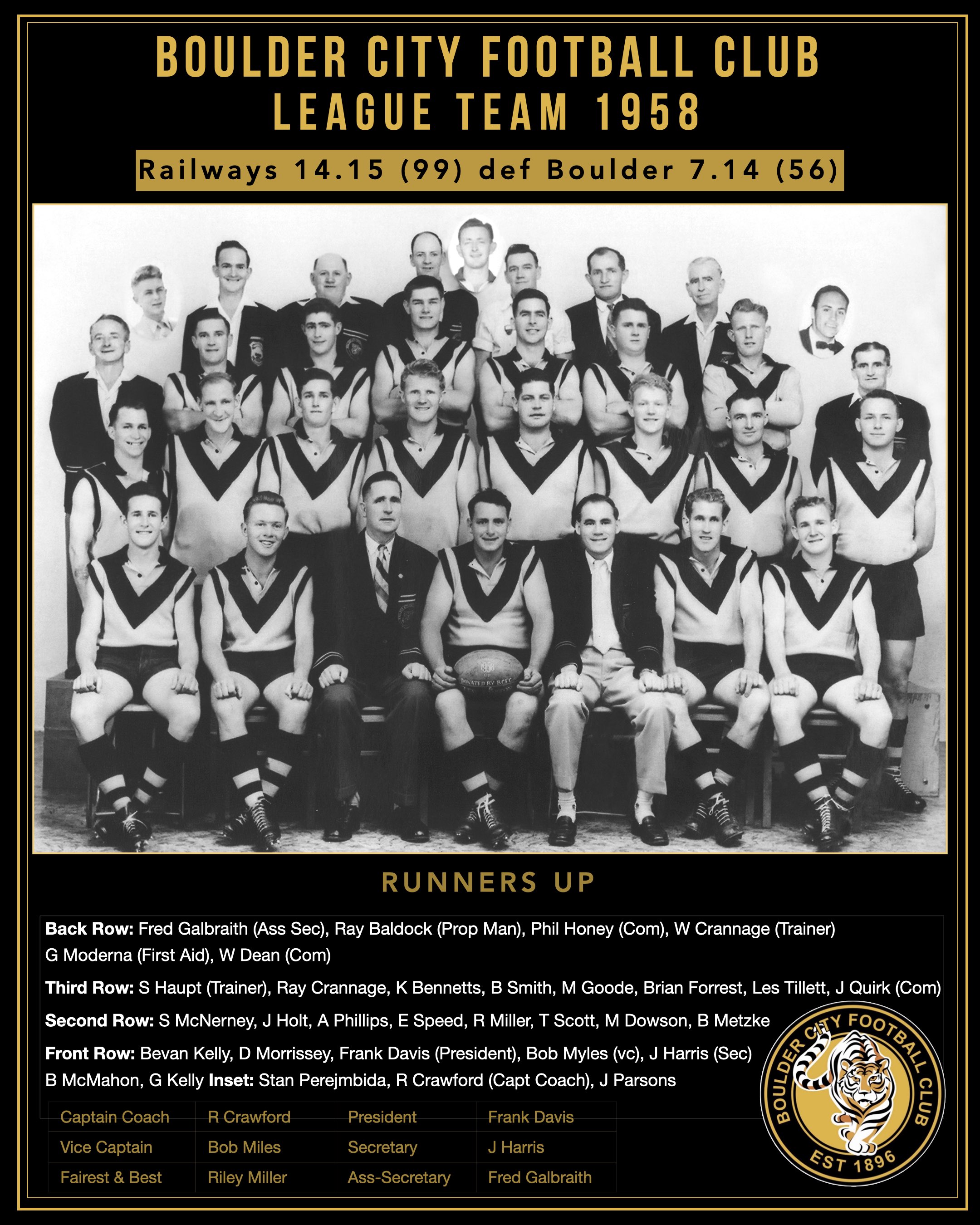
Although Riley Miller's Boulder playing career extended across just three seasons, from 1957 to 1959, his individual achievements were remarkable. In 1958 he was named the Golden Mile Footballer of the Year. He won the Tigers' Fairest and Best award in both 1958 and 1959. He also claimed the Sunday Times Medal in consecutive seasons, 1958 and 1959. Those honours tell us something important. Miller was not simply a colourful personality or an intimidating opponent. He was an outstanding footballer. A player whose strength, mobility, consistency and competitive spirit earned recognition both within his own club and across the Goldfields football community. His reputation as an All-Star full-back was built on performances, not merely stories.
A TIGER FROM ANOTHER ERA
Football has changed enormously since Riley Miller patrolled the last line of defence at Boulder Oval. Coaching methods have changed. Expectations of players have changed. And the physical boundaries of the game have changed. But the characters who helped shape the Boulder City Football Club remain part of its identity. Riley Miller belonged to an era of tough contests, uncompromising footballers and larger-than-life personalities.
He was a policeman who demanded discipline, a coach who believed in direct football and a full-back who could turn defence into attack with one thundering run down the centre. His three seasons in black and gold left behind two club Fairest and Best awards, two Sunday Times Medals, a Golden Mile Footballer of the Year honour and a collection of stories that deserve to be remembered. Riley Miller — the policeman who ruled the corridor.
Another remarkable character preserved in the Boulder Tigers Digital Museum.
FOOTBALL, TEACHING AND THE ROAD BACK HOME 1960–1966
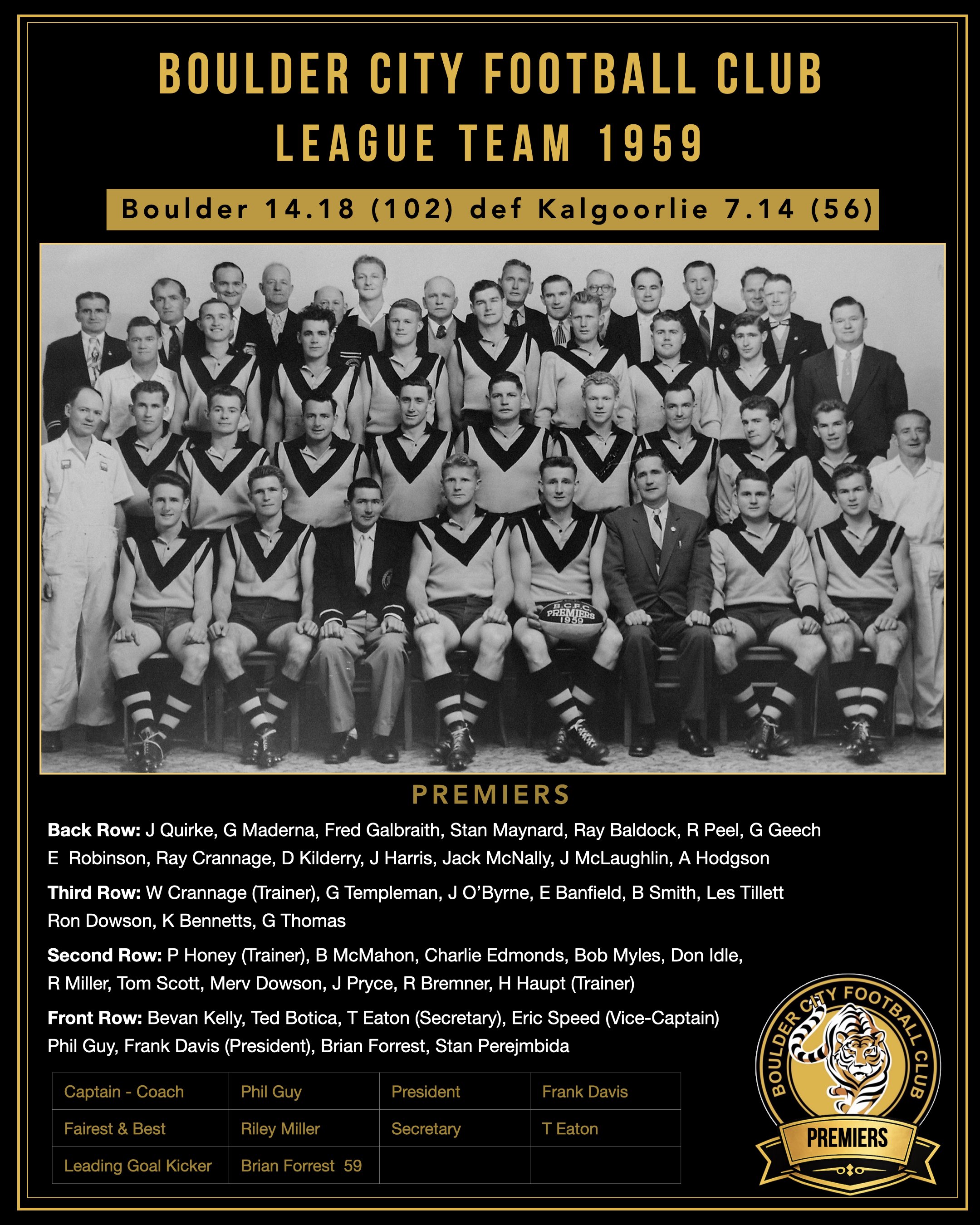
Following the premiership success, Tom's career and education took him away from the Goldfields.
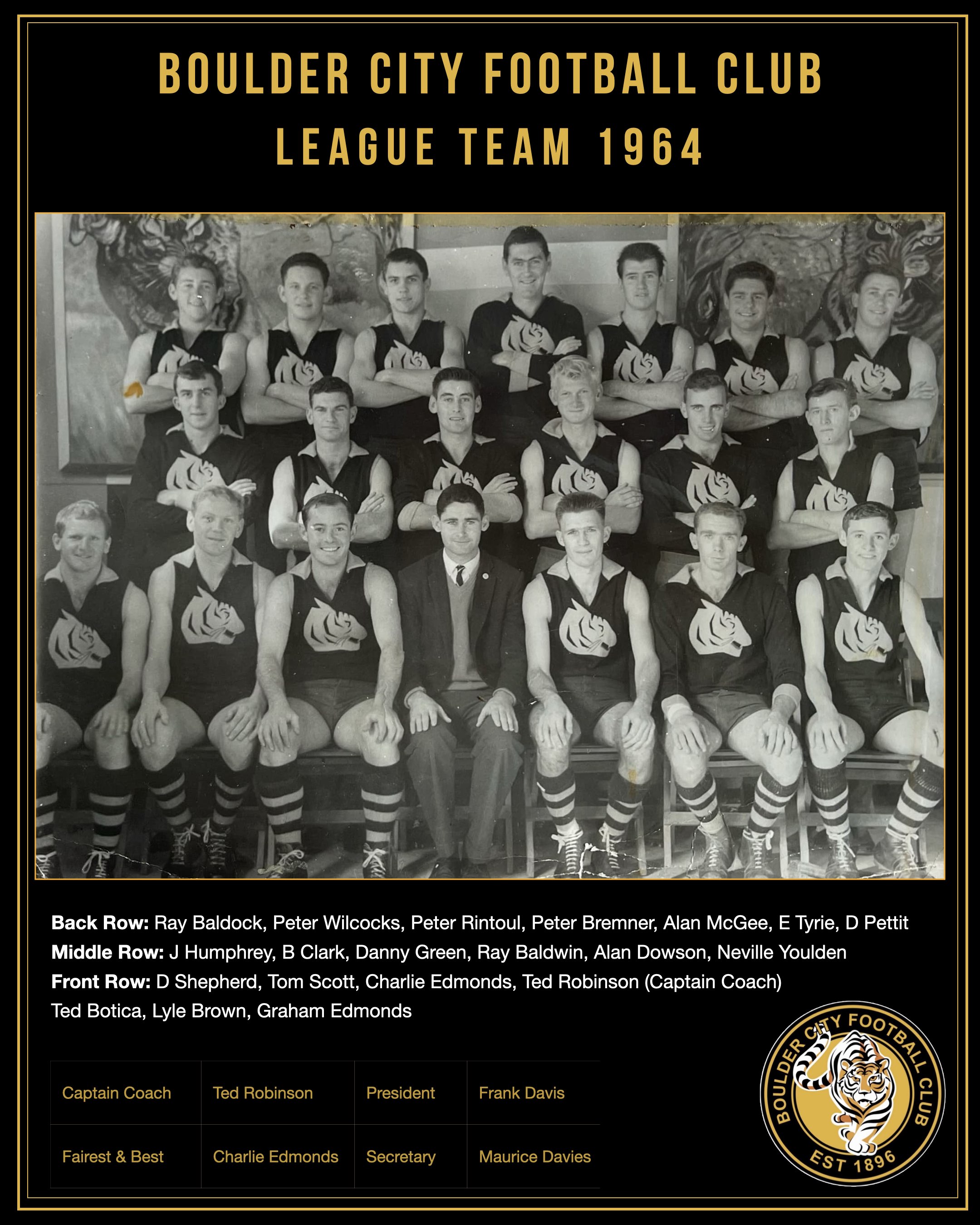
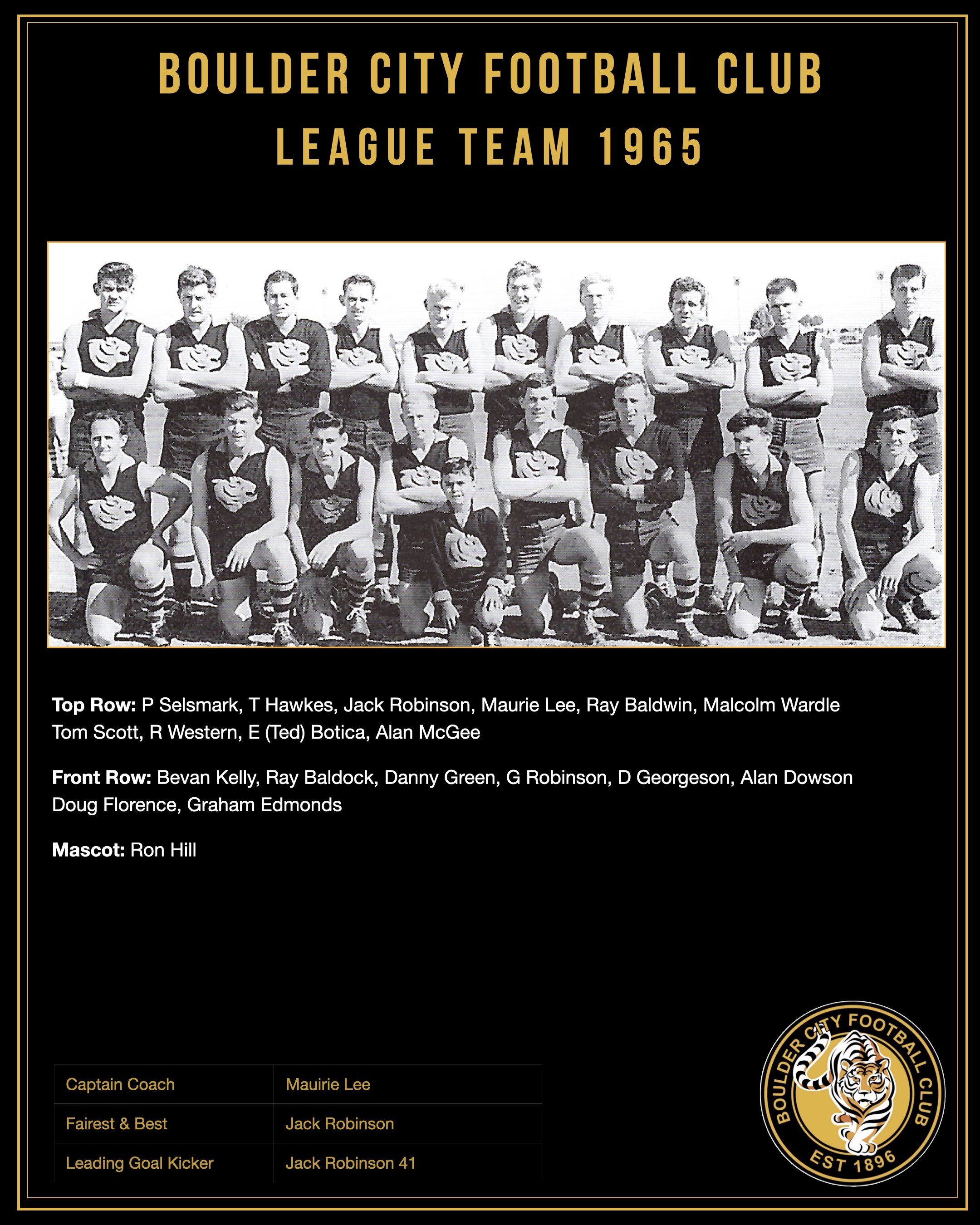
In 1960 and 1961, he attended Claremont Teachers College, preparing for the profession that would become his life's work. Football remained an important part of the journey. In 1962, he spent a brief period playing with the Claremont Reserves. The following year brought another unusual chapter. While based in Perth, Tom travelled to represent Boyup Brook in 1963, an arrangement that demonstrated just how strong his commitment to football remained. His performances earned him selection in the South West Combined Team. But the pull of Boulder was never far away. In 1964, Scotty returned to the Tigers, playing under Ted “Punter” Robinson. Maurie Lee took over the coaching responsibilities in 1965. Then came 1966. Boulder reached the League Grand Final, only to suffer a heartbreaking defeat at the hands of Railways.
For Tom, who had tasted premiership glory seven years earlier, it was a reminder that football could deliver disappointment as readily as triumph. The highs and lows were all part of the journey. And throughout those years, the Tigers remained an important part of his life.
THE TEACHER AND THE TIGER - Lessons Beyond the Boundary
While Tom was contributing to Boulder on the football field, he was also establishing himself in the teaching profession. He taught at Kalgoorlie Central School, working under headmaster Geoff Robinson — himself a devoted Boulder man. It was another example of the close connections between the football club and the wider Goldfields community.
For Scotty, teaching and football shared many of the same principles.
-
Teamwork
-
Respect
-
Responsibility
-
Humility
And the importance of helping others achieve their potential. The qualities that made a good teammate were often the same qualities that made a good teacher. Tom eventually progressed through the education system to become a school principal, building a career founded on leadership and service. He also contributed to football as a coach, extending his involvement beyond his playing years. In both professions, his influence reached beyond immediate results. The real measure was what he could contribute to other people.
THE MEN WHO MADE THE TIGERS - Mentors, Mates and Memories
Ask Scotty who helped shape his football journey and one name comes immediately to mind. Jack McNally. Among the many respected personalities associated with Boulder during that era, McNally left a lasting impression on the young Tiger. But there were plenty of others. When invited to imagine one more dinner with three figures from his football past, Tom's choices were revealing.
-
Alan Dowson
-
Ted Robinson
-
Doug Shepherd
Three names that bring back an era of Tiger football when friendships were forged on the field and strengthened around the dinner table. And then there were the characters. Every football generation has them. The men whose stories become larger with every reunion. For Scotty, one particularly memorable scene involved Johnny O'Byrne, standing on the bar at the Main Reef Hotel and entertaining the entire room with jokes. It was the sort of moment that rarely appeared in football records. But it was precisely the sort of memory that made the club special.
-
The laughter
-
The characters
-
The friendships
-
The stories that were still being told decades later
Those memories are every bit as important to Boulder City's history as the premiership scores.
STILL A TIGER - A Lifetime of Black and Gold
Today, Tom Scott lives in Australind. Many years have passed since the young footballer from Lakewood first pulled on a Boulder jumper. The teammates have grown older. The football grounds have changed. Generations of new players have followed. But Scotty's connection to Boulder City remains. He belongs to that remarkable generation of Tigers who helped establish the club's enduring identity during the 1950s and 1960s.
-
A junior captain
-
A League premiership player
-
A footballer who represented clubs beyond the Goldfields
-
A former coach
-
A teacher and school principal
And, above all, a man who never forgot the people and experiences that shaped his early years. His story reminds us that a football club's influence does not end when a player hangs up his boots. The friendships endure. The lessons remain. And the memories become part of the club's history.
THE LAST WORD — THE 1959 TIGER
When asked to identify his greatest football memory, Tom Scott didn't nominate an individual achievement.
He remembered a team. A group of men. A premiership. And a moment in 1959 when the Boulder Tigers were the best in the Goldfields. Perhaps that tells us everything we need to know about Scotty.The team always came first. And the club was something to carry with you for life.
TOM “SCOTTY” SCOTT
-
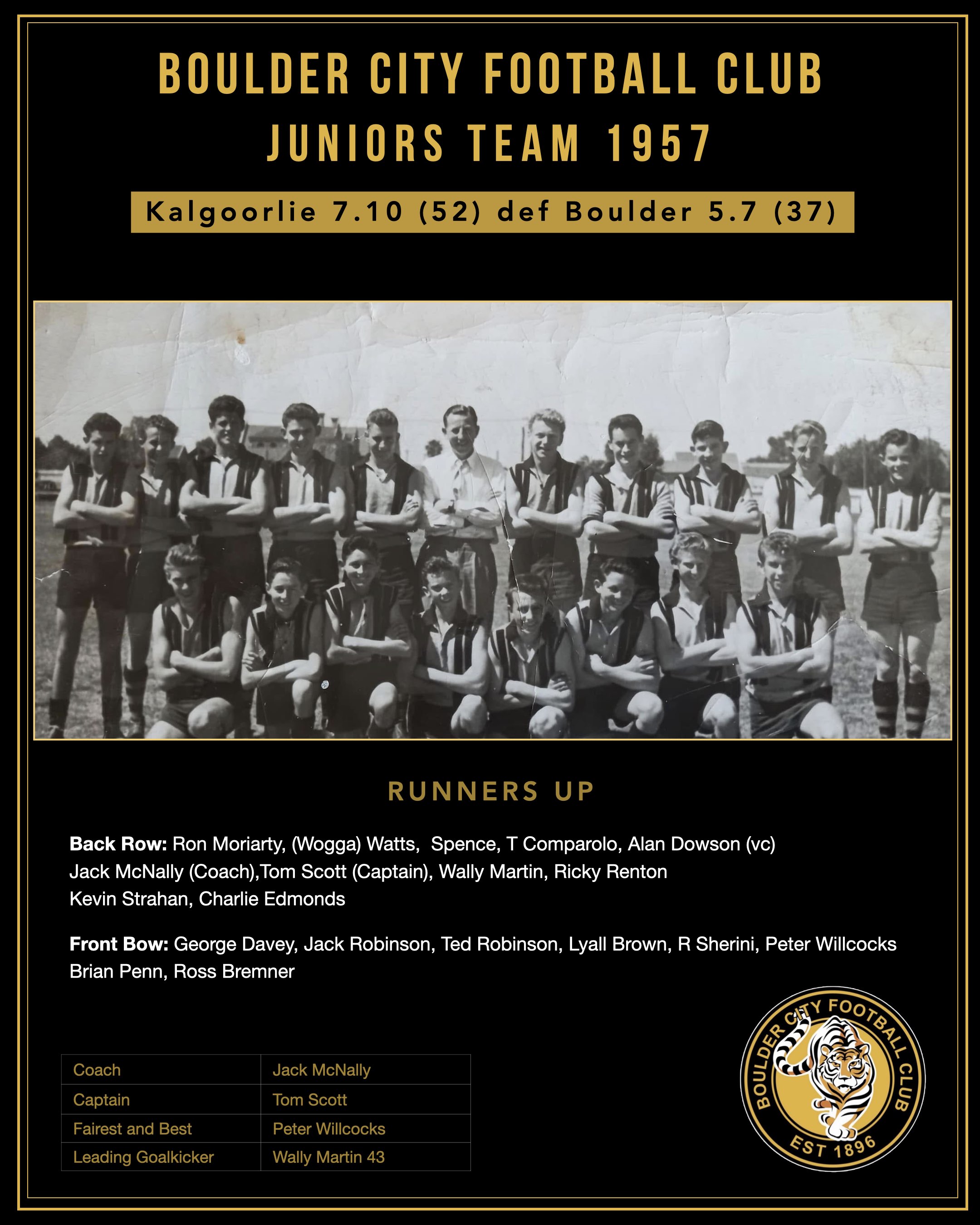
1957 — Boulder Junior Captain
-
1959 — Boulder City League Premiership Player
-
1962 — Claremont Reserves
-
1963 — Boyup Brook and South West Combined Team
-
1964 — Returned to Boulder City
-
Boulder City Coach
A Tiger of the golden era. A gentleman of the game. A Tiger forever.
Boulder Tigers — Past, Present & Future