

Neville 'Inky' Way
From Boulder City to Football Greatness — and a Life in Medicine





Norwood Museum
SANFL Representative
9 Games
BCFC 1941
Goldrush Era - 2000
GFL All Star Team
Wikipedia
Born in Boulder on 16 March 1924, Neville James “Inky” Way was the second son of Dr Inman Way, a local general practitioner. Long before he established himself as one of South Australia's outstanding footballers, young Neville was already demonstrating exceptional sporting ability on the Goldfields.
At just 15, he was the Goldfields' leading scorer in the A-Section final of the 1939 Country Week cricket carnival. The following year, he was a member of the Goldfields' championship-winning cricket team. Football soon became another stage for his talents.
In 1940, still only 16, Way broke into senior Goldfields football with Boulder City, playing at full-forward. The Tigers reached that year's Grand Final against Mines Rovers. It was a match Neville would remember for many years. His direct opponent was Lou Daily, the 1935 Sandover Medallist, then playing at full-back for Mines Rovers.
Mines won the premiership comfortably, but the experience placed the young Tiger against one of Western Australian football's most accomplished players.
By 1941, Way had established himself as a promising Boulder City footballer. Later that year, his journey would take him away from the Goldfields, eventually into wartime naval service, VFL football with St Kilda, and a distinguished career with Norwood in South Australia.
From the Goldfields to the VFL
In 1942, aged just 18, Way enlisted in the Royal Australian Navy during the Second World War. Stationed at HMAS Cerberus in Victoria for training, he found an opportunity to continue playing football. That opportunity took him to St Kilda in the Victorian Football League. Despite his youth and the disruptions of wartime, Way played eight senior VFL matches, kicking seven goals. For a young footballer from Boulder, it was an extraordinary achievement.
A Champion at Norwood
After leaving the Navy, Way moved to Adelaide, where he studied medicine at the University of Adelaide and joined Norwood. Between 1944 and 1950, he established himself as an outstanding centre half-forward and follower, playing 87 matches, including appearances with the combined Norwood–North Adelaide wartime team.
His achievements included:
-
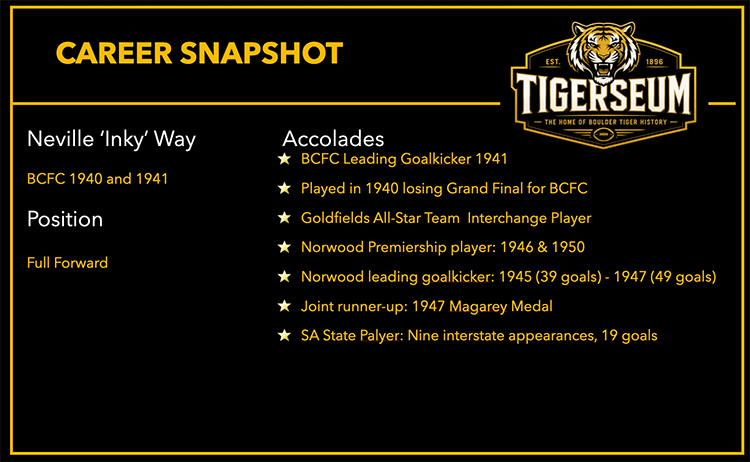
Norwood premiership player: 1946 and 1950
-
Norwood leading goalkicker: 1945 (39 goals) and 1947 (49 goals)
-
Joint runner-up: 1947 Magarey Medal
-
South Australian representative: Nine interstate appearances, 19 goals
-
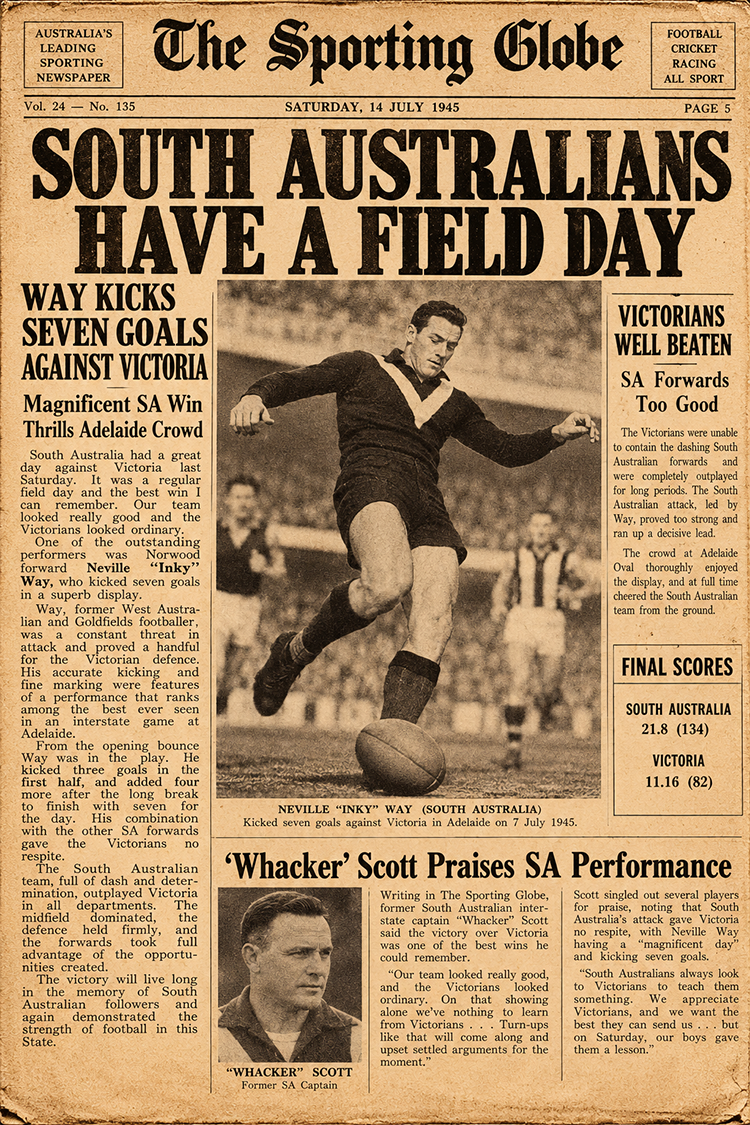
Seven goals against Victoria: South Australia's 52-point interstate victory in 1945'
He was also recognised as Best and Fairest in the combined Norwood–North Adelaide wartime premiership side. His seven-goal performance against Victoria was especially memorable. It demonstrated that a footballer whose career began on the Goldfields could excel against the strongest opposition in the country.


From Football to the Operating Theatre
While football brought Way recognition, his professional achievements were equally significant. He began his medical career at Royal Adelaide Hospital before travelling to England in 1953 for further training. During his two years overseas, he qualified as a Fellow of the Royal College of Surgeons of England. Returning to Australia, he joined Royal Perth Hospital, where he worked as a general surgeon until his retirement in 1989.
It was another remarkable career — this time devoted to medicine and the care of others. A Life That Began in Boulder. Neville James Way died on 13 June 2018, aged 94.
His journey had taken him from Boulder City to St Kilda, Norwood, interstate football and the operating theatres of Royal Perth Hospital. He had represented South Australia, won premierships, earned individual football honours and established a distinguished medical career.
Yet the first chapter of that extraordinary story was written on the Goldfields.
Neville “Inky” Way — Boulder City footballer, interstate champion, premiership player, surgeon and Tiger legend.


Historical reconstruction based on The Kalgoorlie Miner, Monday 1 September 1941, page 2.
One archival distinction: the match-action photograph and Krepp portrait in this design are illustrative, not verified historical photographs. The match result and tactical details come from the original report.


