top of page


Lindsay 'Blue' Richards
THE GOAT


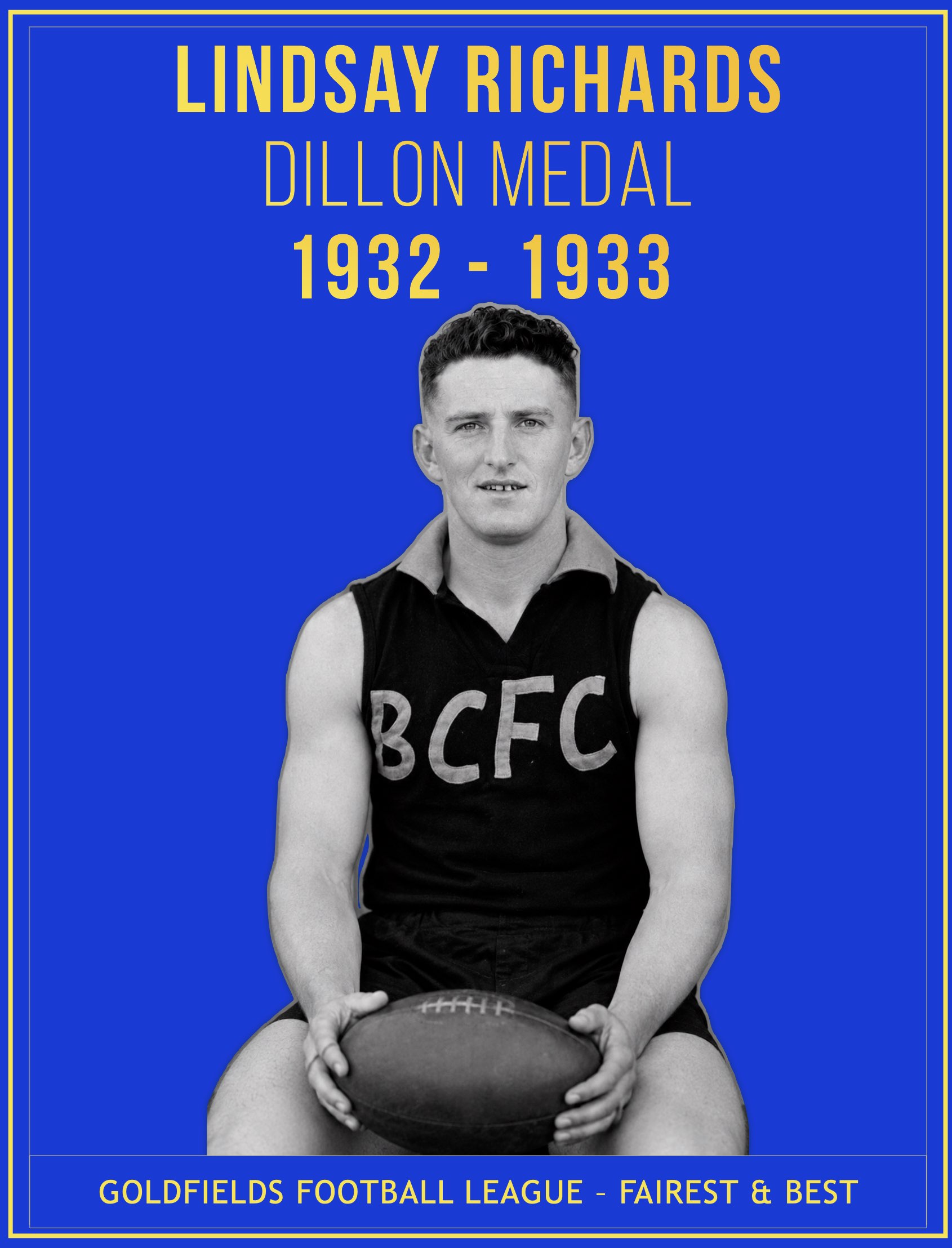

BCFC Captain
BCFC Coach
BCFC Premierships
1928 - 1932 - 1933
GFL F&B
1928
BCFC F&B
1928

LINDSAY “BLUE” RICHARDS
1909–1992 | Boulder City • East Fremantle • South Melbourne
From the Golden Mile to the Melbourne Cricket Ground — the remarkable football life of one of the Goldfields' greatest champions.
9
Consecutive Grand Finals
6
Premierships
1931
Sandover Medal
The Boy from Boulder | 1909–1928 | A champion emerges
Before the Sandover Medal, before the great premiership teams of East Fremantle, and long before the roar of the Melbourne Cricket Ground, there was a boy growing up in Boulder. His name was Lindsay Gordon Richards.
Born on 27 March 1909, Richards grew up in the heart of the Western Australian Goldfields, attending Boulder Central School and developing the natural sporting ability that would eventually carry him into the highest ranks of Australian football. There was nothing particularly imposing about his physical stature. At approximately 180 centimetres and 76 kilograms, Richards was not the biggest footballer on the field. But size was never what made him exceptional. He possessed remarkable judgement, speed across the ground, clean marking hands and the ability to read the play before his opponents. Those qualities would become the foundation of a career built largely around one of football's most demanding positions — centre half-back.
A Tiger at Sixteen
In 1925, aged just sixteen, Richards was a member of Boulder City's premiership team. It was an extraordinary introduction to senior football for a young player who was still developing physically and learning the game. He also established himself as a talented cricketer, representing the highly regarded South-West Boulder Cricket Club. Football, however, was where his greatest achievements awaited.
Richards spent the 1927 season with East Fremantle before returning home to Boulder City in 1928. That return proved significant. Boulder won the 1928 premiership, and Richards claimed the Dillon Medal as the Goldfields Football League's fairest and best player.
At nineteen years of age, he was already a premiership footballer and a league medal winner. Yet his greatest football years were still ahead of him. The Goldfields had produced a champion. The rest of Australia was about to discover him.


Sandover Medal
1931
East Fremantle F&B
1931
East Fremantle Premiers
1929 - 1930 - 1931
East Fremantle
Hall of Fame
WA State Representative


THE CHAMPION COMES HOME
By 1931, Lindsay “Blue” Richards was no longer simply a promising footballer from Boulder. He had become one of the finest defenders in Western Australia. Returning to East Fremantle in 1929, Richards established himself at centre half-back in a side entering a remarkable period of success. Three seasons produced three premierships — 1929, 1930 and 1931. Richards was at the heart of them.
His outstanding defensive performances drew increasing praise from the football press. He was admired for his speed, powerful kicking, aerial judgement and unusually consistent form. One newspaper even pleaded for the defender to have a day off, such was the frequency with which his performances dominated match reports.
The Sandover Medal — 1931
In 1931, Richards reached the pinnacle of individual recognition in Western Australian football. Polling 24 votes, he won the Sandover Medal by five votes from R. Cooper of Claremont-Cottesloe. He became the first East Fremantle player to receive the prestigious award. That same season, he also won East Fremantle's Lynn Medal as the club's fairest and best player. The achievement was especially significant because Richards was not a prolific goalkicker or a glamorous forward. He was a defender whose reading of the game, marking and consistent excellence commanded the attention of umpires, journalists and opponents alike. He had also represented Western Australia at the 1930 Adelaide Carnival.
A Champion Returns to Boulder
Then, at the height of his football reputation, Richards came home. In 1932, Boulder City welcomed back the reigning Sandover Medallist and appointed him captain-coach. For the Tigers, it was an extraordinary appointment. Their new leader was just 23 years old, yet already possessed four senior premierships, a Sandover Medal, interstate experience and a reputation as one of Western Australia's finest players.
What followed was a golden period.
Boulder City won the premiership in both 1932 and 1933. Richards also won the league's fairest and best award in both seasons, together with two Boulder City club fairest and best awards. He had returned to the club that helped launch his career — and delivered two more flags.
Five Grand Finals, Five Premierships
By the end of 1933, Richards had played in six consecutive Grand Finals since 1928. He had won every one. Three different premiership seasons with East Fremantle, three with Boulder City across his career, and a growing reputation as a player capable of transforming the fortunes of a football team. For Boulder supporters, his return was more than a homecoming. It was a champion giving something extraordinary back to the club where his football journey began.



GFL
Hall of Fame
Goldrush Era - 2000
GFL All Star Team
South Melbourne
Grand Finalists
Wikipedia
Australian Football
NINE GRAND FINALS. ONE EXTRAORDINARY CAREER.
Six consecutive Grand Finals. Six premierships. By the end of 1933, Lindsay “Blue” Richards had already assembled a football record that most players could only dream of. But his journey was far from finished.
In 1934, Richards joined South Melbourne in the Victorian Football League, becoming part of the club's celebrated era of interstate recruiting.
Once again, he found himself playing in a team competing for the premiership. And once again, he reached the Grand Final. From Boulder to the MCG Richards played in South Melbourne's Grand Final teams in 1934, 1935 and 1936. The results were different from those he had enjoyed in Western Australia.
South Melbourne lost all three. But Richards had now achieved something remarkable: nine consecutive Grand Final appearances across three football clubs and three different competitions. The crowds at the Melbourne Cricket Ground were enormous. In 1934, 65,335 spectators attended. In 1935, the attendance was 54,154. And in 1936, 74,091 watched the premiership decider.
For a footballer who had first played senior football as a sixteen-year-old in Boulder, these were extraordinary stages on which to perform. So Valuable They Called Him Back In 1935, Richards moved to Broken Hill to operate a sports shop. Yet South Melbourne still valued his ability so highly that he was brought back for the club's 1936 finals campaign.
His playing career ultimately included 39 VFL games for South Melbourne, following 59 appearances with East Fremantle and his distinguished years with Boulder City. He had also represented Western Australia and won football's highest individual honour in the WAFL.
The Legacy of Blue Richards
Richards later served in the Australian Army during World War II. In retirement, he settled at Frankston in Victoria, where he died on Anzac Day, 25 April 1992, aged 83. His achievements continued to receive recognition long after his playing days.
In 1997, East Fremantle named him in its official Team of the Century. He was inducted into the Goldfields Sporting Hall of Fame in 2009 and was subsequently selected on a half-back flank in the Goldfields Best Team for 1900–2020. But perhaps the greatest measure of his career is the record he left behind.
Nine consecutive Grand Finals.
-
Six premierships.
-
A Sandover Medal.
-
Three Goldfields league fairest and best awards.
-
Two premierships as Boulder City captain-coach.
And a reputation as one of the finest defenders ever produced by the Goldfields. He left Boulder to conquer the game. He came home to make the Tigers champions. Then he took his extraordinary talents to the biggest stage in Australian football.
Lindsay “Blue” Richards. - Forever a Boulder Tiger.


Past Players
130 Year Book
Digital Museum
Honour Boards
bottom of page