

Don Marinko
From the Golden Mile to the WA Football Hall of Fame



BCFC
1924 - 1925
Goldrush Era - 2000
GFL All Star Team
WA Hall of Fame
All Star Teams
Wikipedia


West Perth
F&B - 1933
West Perth
Hall of Fame
West Perth
Premierships
Slurs
Kalgoorlie Miner
1924–1925 Boulder City Premiership Player | 1930 Sandover Medallist | Western Australian State Representative |
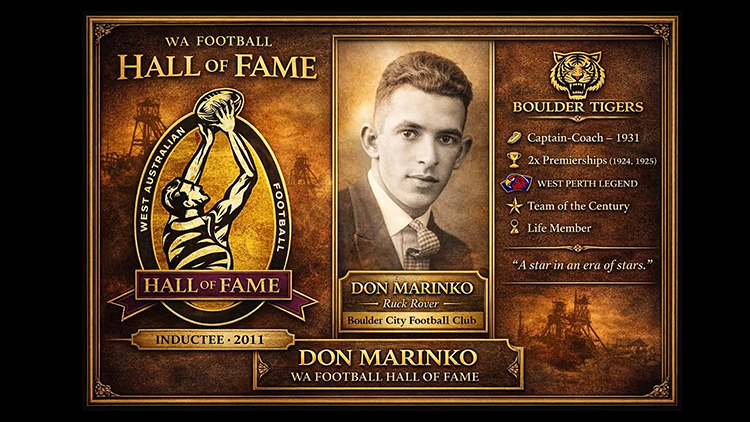
WA Football Hall of Fame
Some footballers leave their mark on a club. Others go on to leave their mark on the game itself. Don Marinko did both. Long before he became a celebrated West Perth champion, a Sandover Medallist and a member of the Western Australian Football Hall of Fame, Don Marinko was a young footballer from the Golden Mile who helped the Boulder Tigers win consecutive premierships. His remarkable journey would take him from the mining fields of Kalgoorlie-Boulder to the highest levels of Western Australian football. And along the way, he would develop a reputation as one of the most stylish, skilful and influential footballers of his generation.
A Boy from the Golden Mile
Donald Marinko was born at Kamballie on the Golden Mile on 27 August 1907. Football came naturally to the young Goldfields boy, although his earliest development took place away from home. While attending Christian Brothers College in Perth, Marinko's exceptional ability attracted the attention of the Subiaco Football Club. Standing approximately 180 centimetres tall, he was already a strong, athletic youngster with the physical presence and natural skills to compete against older footballers. On 23 June 1923, still two months short of his sixteenth birthday, Marinko made his senior league debut for Subiaco. He began in a forward pocket and immediately demonstrated his potential.
The West Australian newspaper recognised the young debutant, reporting:
“A word of praise should be given to young Marinko who signalised his debut in league football with a fine mark and a good kick for a goal.”
It was an extraordinary beginning for a boy not yet sixteen. But his next chapter would take him home. Back to Boulder — Two Premierships After three senior appearances with Subiaco in 1923, Marinko returned to the Goldfields, where he began working underground on the Golden Mile. He joined the Boulder City Football Club at a time when the Tigers were building a formidable side. The young Marinko quickly established himself as a footballer of exceptional promise. His combination of strength, agility and football intelligence made him a valuable contributor, whether competing in the ruck or moving forward. And the success came quickly. In 1924, Boulder City won the premiership. In 1925, they did it again. For a teenager still developing his game, two consecutive senior premierships represented a remarkable achievement.
Those seasons also helped establish Marinko's growing reputation throughout Goldfields football. He was no longer simply a promising schoolboy who had briefly played league football in Perth. He was a dual premiership Tiger. And the metropolitan clubs were watching. A Twist of Fate — West Perth's Gain When Marinko decided to return to the metropolitan competition, several clubs were interested in securing his services. An arrangement had been made for him to join East Perth. But football's residential qualification rules intervened. Having taken up residence in Osborne Park, Marinko was found to be residentially bound to West Perth. What initially appeared to be a frustrating complication would become one of the most fortunate developments in West Perth's history. East Perth missed out. West Perth gained a champion.
Marinko would become one of the defining players of a golden era for the Cardinals. His career was built on much more than physical strength. For a big man, he possessed remarkable speed, balance and agility. He could take a spectacular mark, turn sharply out of trouble and deliver the football with extraordinary precision. And there was one particular skill that became legendary. His left-foot stab pass.
The Man Behind Hundreds of Goals
Football history remembers West Perth full-forward Ted Tyson as one of the game's greatest goalkickers. But Tyson himself never forgot the teammate who supplied so many of his opportunities. Don Marinko's accurate eft-foot passing became a devastating weapon in West Perth's attacking game. He could drive the ball hard and low to a leading forward or soften his delivery when a teammate had found space. It was a rare combination of judgement, timing and execution. After Marinko's death, Tyson reflected on their remarkable partnership and credited approximately 500 of his 1,197 goals to the delivery of Big Don. His assessment was emphatic:
“He was one of the best stab passes I've seen and hit his target 90% of the time.” Tyson explained that Marinko had the ability to adjust the weight of his kick perfectly, whether his full-forward was leading at speed or breaking into open space. For football followers who never had the opportunity to watch Marinko play, those words offer a remarkable insight into his talent. He wasn't simply getting the ball forward. He was creating goals through skill.
A Footballer They Called a Champion
The newspapers of the era were equally impressed. On 13 September 1929, the Westralian Worker described Marinko as probably the best player in league football at the time. The report praised his dash, clever turning, secure marking and outstanding work in the ruck. Four years later, the WA Footballer offered another glowing assessment.
Writing on 15 July 1933, the newspaper declared:
“His passing of the ball 'a thing of beauty and joy forever'. He is a champion.” Such praise was not based on a single outstanding performance. It reflected years of consistent excellence. Marinko was a footballer who could influence a match in several positions, combining the physical authority of a ruckman with the finesse of a skilled forward. And his achievements continued to accumulate.


Medals, Premierships and State Honours
In 1930, Don Marinko reached one of the great milestones of his career when he won the Sandover Medal, recognising him as the outstanding fairest and best footballer in the Western Australian league competition.
It was a remarkable individual honour for a player who had begun his football journey on the Golden Mile.
But team success remained central to his career.
With West Perth, Marinko became a three-time premiership player, celebrating flags in 1932, 1934 and 1935.
He captained the club to the latter two premierships. In 1933, he added West Perth's Fairest and Best award to his achievements. His outstanding performances also earned him thirteen appearances representing Western Australia between 1928 and 1936. Across those years, Marinko was regularly recognised among the State's leading performers. The boy who had once helped Boulder City win back-to-back premierships was now one of Western Australian football's most accomplished players.
A Football Family
Don Marinko's contribution to football extended beyond his own playing career. He and his wife raised two sons who would follow their father into senior WAFL football. Donald Anthony Marinko and Raymond George Marinko both went on to play for West Perth and East Perth during the 1950s. It was only when his son Donald began his own senior career that the original Don Marinko became widely distinguished as Don Marinko Senior. The family name had become part of Western Australian football across two generations. For Don Snr, there must have been considerable satisfaction in watching his sons establish their own places in the game he had served so brilliantly. His own playing career had ended in 1939, but the Marinko football story continued.
A Legacy Recognised
Don Marinko died suddenly from a heart attack in 1967, aged 59. Yet the passing years did little to diminish his reputation. In October 2000, West Perth selected him on a half-forward flank in its Team of the Century.
It was a fitting recognition of a player whose influence had extended well beyond individual statistics.
In March 2011, another major honour followed when he was inducted into the Western Australian Football Hall of Fame.He was also named in the Goldfields All-Star Team selected in 2020, further acknowledging the extraordinary contribution of footballers who emerged from the region. His name now stands alongside some of the greatest players in Western Australian football history.
The Boulder Connection
For the Boulder City Football Club, Don Marinko's story carries particular significance. His years at Boulder were relatively brief, but they were enormously successful. He was part of two premiership teams before his twentieth birthday. Those seasons helped shape a footballer who would go on to become a Sandover Medallist, a State representative, a premiership captain and a Hall of Fame inductee. His achievements also remind us of the remarkable quality of football played on the Goldfields during that era. The region was not simply producing footballers capable of competing at higher levels. It was producing champions. And Don Marinko was unquestionably one of them.
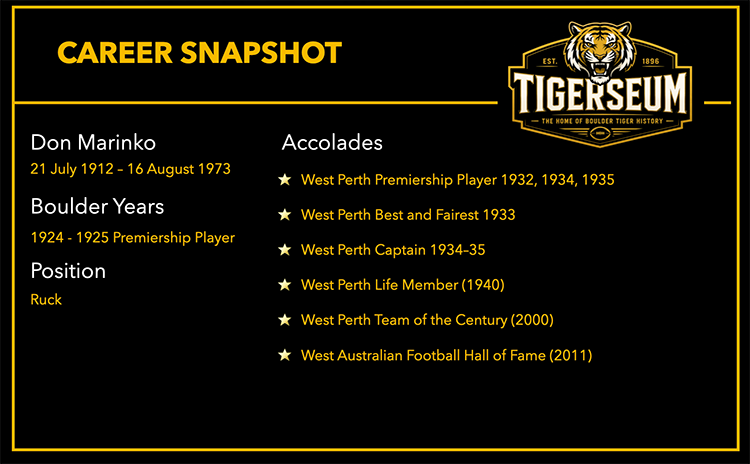
Career Snapshot
Boulder City Football Club
-
Premiership Player — 1924, 1925
West Perth Football Club
-
1930 Sandover Medallist
-
Fairest and Best — 1933
-
Premiership Player — 1932, 1934, 1935
-
Premiership Captain — 1934, 1935
-
Western Australian State Representative — 13 games
-
West Perth Life Member
-
West Perth Team of the Century — Half-forward flank
Football Honours
-
Western Australian Football Hall of Fame — 2011
-
Goldfields All-Star Team — 2020
From Boulder to Football Immortality
There is something particularly special about tracing the careers of footballers who began their journeys on the Goldfields. Their names appear in old team lists, newspaper reports and premiership records. Sometimes their Boulder years occupy only a small part of a much larger football story. But those years matter. For Don Marinko, they included two premierships, lifelong memories and the early development of the extraordinary football ability that would make him famous. He went on to become one of West Perth's greats.
One of Western Australia's finest.
And a member of the Football Hall of Fame.
But before all those honours, Don Marinko was a Boulder Tiger.
A champion of his era.
A master of his craft.
A legacy that began on the Golden Mile




THREE MARINKOS — ONE REMARKABLE FOOTBALL FAMILY
The name Marinko occupies a special place in Western Australian football history. Don Marinko Senior had already established himself as one of the great ruckmen of his generation. A former Boulder City footballer, West Perth champion and regular Western Australian representative, his career had taken him from the Goldfields to the highest levels of State football. But the Marinko story did not end with Don Senior. His sons were following in his footsteps.
Don Junior, aged just 20, had earned selection in Western Australia's State carnival team, while 17-year-old Ray had been chosen to represent the Metropolitan Juniors Association against Victorian opposition.
Three members of one family. Three representative footballers.


