

OUR STORY • OUR PEOPLE • OUR CLUB
1896
2026
The Beginning
1900s
1910s
1920s
1930s
1940s
1950s
1960s
1970s
1980s
1990s
2000s
2010s
2020s
and Beyond

THE MAYNARD FAMILY
“The Club People”
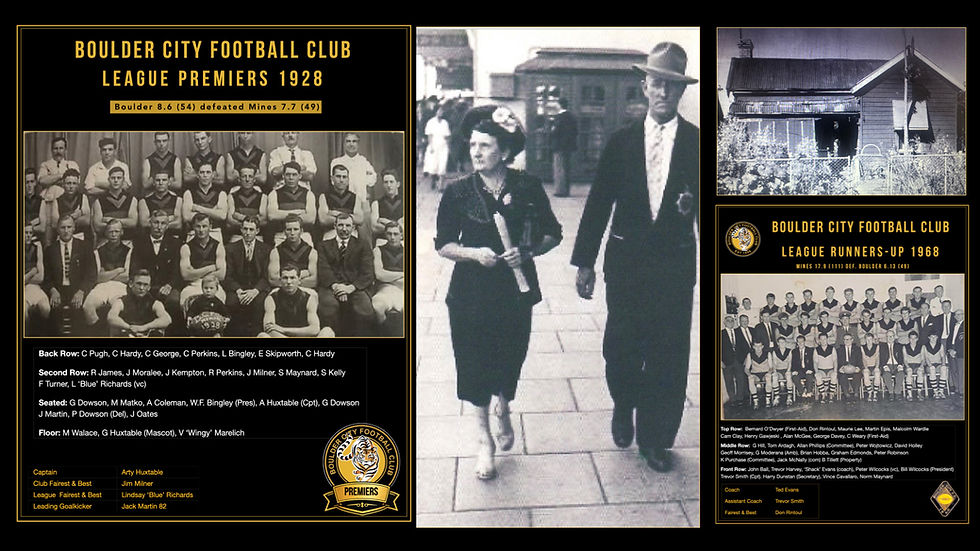
“Every football club has families who become part of its history. The Maynards became part of its heart.”
Every football club has families whose names become familiar across generations. Names heard around the change rooms. Names found in old team photographs. Names appearing in committee records, newspaper clippings and stories told over the bar long after the people themselves have gone.
At the Boulder City Football Club, one of those names is Maynard.
The Maynards were not a football dynasty built around generations of champion players. Their story is something broader. They were club people. Their connection with Boulder stretched from the pioneering years of Goldfields football through junior teams, senior football, family gatherings and decades of Saturday afternoons following the black and gold.
At the centre of it all stood one remarkable man.
Their connection with Boulder stretched from the pioneering years of Goldfields football through junior teams, senior football, family gatherings and decades of Saturday afternoons following the black and gold.
At the centre of it all stood one remarkable man. Stanley Norman Maynard.
Footballer. Miner. Life Member. Family man. And, when circumstances demanded it, a man prepared to descend into the darkness of an abandoned mine shaft to save the life of a child.
STAN MAYNARD - ONE OF THE EARLY TIGERS
Stan Maynard belonged to the generation that helped establish Boulder City Football Club as far more than simply a Saturday football team. His place in the club’s history is permanently recorded beside his name:
Stanley Norman Maynard
Life Member No. 7
1932
Being only the seventh person awarded Life Membership tells its own story. Such recognition was never simply about playing well.
-
It represented service.
-
Commitment.
-
Reliability.
Being there when the football club needed you. Stan played in an era when Boulder football remained closely connected to the mining community surrounding it. The footballers spectators watched on Saturday afternoons were often the same men who had spent the working week underground or around the great mining operations that dominated the town. Stan was one of them. During the week he worked as a skilled rigger on the Great Boulder Mine, making wire slings and lifting ropes for the enormous cranes used throughout the mining operation.
It was dangerous and exacting work. There was little room for error. Strength mattered. Skill mattered. Most importantly, the men around you had to trust you. Those same characteristics followed Stan into football.
On Saturdays, the rigger became a Tiger.
HE HAD “MONGREL”
Years later, grandson Norm Maynard used a wonderfully Australian football expression to describe his grandfather.
Stan had “mongrel.” It wasn’t intended to suggest he was dirty. It meant he was competitive. Hard. Determined.
The sort of footballer who didn’t particularly enjoy losing and wasn’t inclined to surrender anything easily. That toughness fitted Boulder football perfectly.
These were footballers playing on hard Goldfields surfaces, many after completing physically demanding working weeks. Matches were uncompromising and rivalries intense.
Stan Maynard belonged in that world.

Stan Maynard belonged to the generation that helped establish Boulder City Football Club as far more than simply a Saturday football team. His place in the club’s history is permanently recorded beside his name:
Stanley Norman Maynard
Life Member No. 7
1932
Being only the seventh person awarded Life Membership tells its own story. Such recognition was never simply about playing well.
-
It represented service.
-
Commitment.
-
Reliability.
Being there when the football club needed you. Stan played in an era when Boulder football remained closely connected to the mining community surrounding it. The footballers spectators watched on Saturday afternoons were often the same men who had spent the working week underground or around the great mining operations that dominated the town. Stan was one of them. During the week he worked as a skilled rigger on the Great Boulder Mine, making wire slings and lifting ropes for the enormous cranes used throughout the mining operation.
It was dangerous and exacting work. There was little room for error. Strength mattered. Skill mattered. Most importantly, the men around you had to trust you. Those same characteristics followed Stan into football.
On Saturdays, the rigger became a Tiger.
THE PLACE KICK
But there was another feature of his football that remained embedded in family folklore long after his playing days ended. His place kick.
THE HAT CAME OFF
Long before the drop punt became universal, footballers employed kicking techniques that have now almost completely disappeared from the game. Stan was remembered as an accomplished exponent of the old-fashioned place kick. And apparently, he had a routine.
-
First, the football was carefully positioned.
-
Then came the important part.
-
Stan removed the felt hat he was famous for wearing.
-
Only then would he step back and prepare his approach.
It is a wonderful image from another football age. A Goldfields crowd around the boundary. A football sitting on the ground. Stan Maynard surveying the goals. And the battered felt hat coming off.
Family stories preserve moments statistics never can. The result of every kick has long disappeared from memory.
The ritual hasn’t.


DOLLY
Alongside Stan throughout much of the story was Dorothy “Dolly” Maynard.
If Stan filled a room, Dolly was different.
-
Quiet.
-
Gentle.
-
Unassuming.
-
Family first.
Football inevitably became part of her life because football was such a significant part of Stan’s, although family recollections suggest darts may have been closer to Dolly’s own sporting passion.
She enjoyed people, family gatherings and, on a warm Goldfields afternoon, a cold beer.
Together Stan and Dolly created the sort of home remembered less for what it looked like than for how people felt when they walked through the door.
-
It was welcoming.
-
Hospitable.
-
Safe.
There always seemed to be room for family and friends. That matters in the story of a football club.
Because country clubs were rarely built only inside clubrooms.
They were built around kitchen tables, on verandahs — or perhaps in the Maynard household, on the “rander” — and wherever football people gathered.

RANDER
As often happens in families, the mistake was too good to correct.
The word survived.
Eventually the nickname somehow found its way onto Stan himself.
Stanley Norman Maynard — footballer, miner and one of Boulder City’s earliest Life Members — became affectionately known as:
“Rander Maynard.”
Nobody needed to explain it.
It was simply part of being a Maynard.
FOUR BOYS
Stan and Dolly raised four sons: Norman — Keith — Colin — Raymond
Interestingly, none became the headline Boulder football star one might expect from such a prominent football father. And that makes the Maynard story more authentic rather than less important. Football families do not always move neatly from champion father to champion son. Sometimes the inheritance is simply belonging. The Tigers remained part of the Maynard family’s world.
There was also tragedy. Two of the sons, Norman and Raymond, died as young men in separate motorcycle accidents. For a close family, the losses were devastating. Yet the family endured. Keith, Norm’s father, and his wife Hilda carried another generation of Maynards forward. And before long, football again entered the story.
NORM’S TURN
By the 1960s, another Norman Maynard was making his way through Boulder football.
Norm Maynard.
His journey provides a wonderful example of the pathway country football clubs once created for their youngsters.
There was no instant arrival into senior football.
You grew through the club.
Norm appeared with the Sub-Juniors in 1964.
By 1967 he had developed into one of the leaders of an exceptional Boulder junior side, serving as vice-captain of the undefeated Junior Premiership team.
That team matters in Boulder history.
It wasn’t simply successful.
It produced footballers capable of taking the next step almost immediately.
Among the young Tigers emerging from that group were names including Brian Hobba, David Holley, Norm Beaton and Norm Maynard.
Within twelve months, some of them would find themselves somewhere extraordinary.
A League Grand Final.
FROM JUNIORS TO THE BIG STAGE
In 1968, Norm Maynard was just 18 years old. Twelve months earlier he had been celebrating an undefeated junior premiership. Now he was lining up in a Boulder League side playing on the biggest stage in Goldfields football.
The 1968 League Grand Final.
The Tigers ultimately finished runners-up, but for an eighteen-year-old Maynard the occasion represented an extraordinary rise.
Junior football one season.
League Grand Final the next.
There was also a peculiarity of the era that Norm remembers with considerable amusement.
The legal drinking age was 21.
So here was an eighteen-year-old considered old enough to pull on a Boulder jumper and play in a League Grand Final… but technically not old enough to legally join some of the celebrations surrounding senior football.
What happened next? Norm’s smile usually tells the story. Some pieces of football history are probably best left there.
By 1969, his football journey continued through the Reserves, extending another chapter of the family’s connection with Boulder.


THE DAY FOOTBALL DIDN’T MATTER
There is, however, one story that perhaps tells us more about Stan Maynard than any football match ever could. It happened in 1950. A two-year-old child had fallen approximately forty feet down an abandoned mine shaft.
For anyone who knew the Goldfields, abandoned shafts represented a terrifying legacy of the mining boom. Dark, deep and dangerous, they could turn an ordinary moment into catastrophe.nA rescue was required. Somebody had to go down. Stan Maynard volunteered. The footballer and rigger suddenly found that the skills of his working life mattered enormously. He descended into the shaft.
Below him was a frightened toddler. Stan calmly reassured the child, secured the youngster for the rescue and helped bring them safely back to the surface. The incident made newspaper headlines.
For the Maynard family, however, the story was entirely consistent with the man they knew. Someone needed help. Stan went. That simple act perhaps explains Life Member No. 7 better than any list of games played or committee positions ever could. Stan Maynard belonged to his community.
MORE THAN ONE FAMILY
Like so many old Goldfields families, the Maynard story does not exist in isolation. Families married into other families. Football connections became community connections. Names that appear separately in historical records often turn out to be joined around the kitchen table.
On Norm’s mother’s side were William and Elizabeth Thomas, originally from Victoria, with another strand of the family’s history connected to a butcher shop. These connections help explain the Boulder of the period. It was not a collection of unrelated footballers who happened to meet on Saturday afternoon. It was a community. People worked together. Families knew one another. Children attended school together. Neighbours became teammates. Teammates became brothers-in-law. And football became one of the great gathering points around which those relationships formed.
THE KEEPER OF THE STORIES
Today, Norm Maynard occupies another important role. He is a keeper of the family story. Old photographs are identified because somebody remembers a face. Stories survive because somebody bothers to tell them. A nickname like “Rander” means nothing unless somebody explains why. An FJ Holden becomes just another old car unless somebody remembers what Grandad occasionally allowed a teenage grandson to do with it. And a name on a Life Membership board becomes simply another name unless someone explains the person behind it.
That is why family history has become so important to the broader history of the Boulder City Football Club.
The official records tell us what happened. Families often tell us what it felt like.
WHAT WOULD STAN THINK?
During our conversations about his family, Norm was asked an interesting question. What would his grandfather think if he could walk through Boulder today?
Norm paused.
-
The town has changed enormously from the Boulder Stan knew.
-
The mines have changed
-
The streets have changed.
-
Families have moved away.
-
Buildings and businesses that once defined everyday life have disappeared.
Norm thought his grandfather might be a little disappointed by some of what had changed. But there is one place where the connection would remain instantly recognisable. The Boulder City Football Club. The jumpers may be different. The grounds are better. The players no longer arrive after a working week like Stan’s on the Great Boulder Mine. Nobody removes a felt hat before attempting a place kick. But the black and gold remains. So does the idea that a football club belongs to the people prepared to keep turning up.
THE CLUB PEOPLE
That is why the Maynards belong among The Families Who Built the Tigers. Not because every generation produced champion footballers. They didn’t.
Not because their name dominates the club’s honour boards. It doesn’t.
Their importance is more human than that. Stan played and served. Dolly created family around him. Their sons carried the name through another generation.
Norm wore the black and gold from junior football to a League Grand Final and eventually became custodian of the memories that came before him. Across those generations runs something impossible to measure in statistics.
-
Belonging.
-
Football clubs need champions.
-
They need premiership teams.
-
They need great coaches and administrators.
-
But they also need something else.
-
They need families who make the place feel like home.
-
People who welcome others.
-
People who remember.
-
People who help when help is required.
-
People who stay.
In 1950, when a child was trapped forty feet underground, Stan Maynard didn’t stand at the top of the shaft waiting for somebody else. He went down. Perhaps that is the Maynard story in one moment.mIf somebody needed help, a Maynard was there.
More than ninety years after Stanley Norman Maynard became Boulder City Football Club Life Member No. 7, his family’s stories remain part of the club.
-
The felt hat.
-
The place kicks.
-
The “rander.”
-
Dolly and her cold beer.
-
The circus rides.
-
The FJ Holden.
-
An undefeated junior premiership.
-
An eighteen-year-old playing in a League Grand Final.
-
And one extraordinary descent into a dark Goldfields mine shaft.
Individually, they are memories. Together, they tell us something much larger. They tell us why the Maynards weren’t simply a family that followed the Boulder City Football Club.
They were Club People.
And for generations of Maynards, Boulder wasn’t simply where football was played. It was home.


